Spinnerbait Blades
Blades give spinnerbaits "Life"
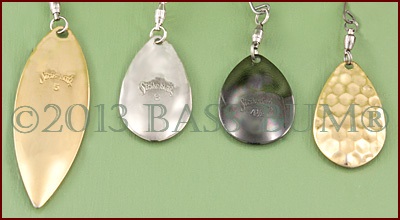
The Three Primary Spinnerbait Blades
| Shape | Characteristics | Colorado | Most popular, usually heavily cupped, significant water resistance creates the most lift and vibration, good for helicoptering and slow retrieves, good for murky water and fishing shallow | Indiana | More narrow and longer than Colorado, a bit pear shaped, but wider than willowleaf, good in current, good where a slow to medium retrieve is sought | Willowleaf | Long, narrow, flash, spins in tight arc causing minimal vibration and lift allow deeper fishing, good along weedlines as they tangle far less than other styles, resembles baitfish |
|---|

With Spinnerbaits It's All About Blade Flash, Vibration and Spin
Blade Flash and Rotation, How Spinnerbaits "Speak To Bass"
On the retrieve all type spinnerbait blades flash, vibrate and spin. So which spinnerbait features determine the magnitude and intensity of a spinnerbait's flash and vibration?
Blade Shape
As illustrated above, there are three main shapes of spinnerbait blades, the Colorado, Indiana and willowleaf. However, there are also turtleback, whiptail, serrated, rippled, v-shaped, hybrid and royal shaped blades available though these are not nearly as popular.
Shape, along with size, significantly affects "vibration" of spinnerbaits. Vibration is an important feature relative to the success potential of one of these lures. The rounder the shape the greater the water displacement. The more displacement the more likely a bass will detect it through its lateral line and move to it "check it out".
Blade Size
The size of spinnerbait blades impacts both flash and speed of a spinnerbait as well as whether the lure runs upright or on its side. Since "running true", that is moving through the water upright, is very important you should pay particular attention to the size blade(s) that come with the lure.
A size No. 8 blade on a 1/4 ounce body will most likely not run upright at all. Put that same blade on a 3/8 ounce body and you have a lure that will run true with a "slow" retrieve but which will probably run at an angle retrieved slowly. If the lure has a blade too large for the the lure or for the speed of retrieve, it will most likely lean to the side and in so doing present an unnatural profile to the bass.
A small blade generates less water resistance so can be retrieved at greater depths and at higher speeds, because there is less "lift".
Blade size also affects the arc of rotation which impacts the amount of vibration. A large blade which spins in a larger arc naturally produces greater vibration and the converse is true with smaller blades.
Generally speaking, if you want fast retrieves use smaller blades and large blades for slower retrieves.
Colorado and Indiana blades are available in sizes 00 to 8 with 8 being the largest. Willowleaf blades come in sizes 1 to 8.
Though there are some differences in standards between manufacturers the chart below reflects "generally accepted" measurements for the three most common blade shapes.
Spinnerbait Blade Size Chart
| Willowleaf | Colorado | Indiana | |||
|---|---|---|---|---|---|
| Size | Length | Size | Length | Size | Length |
| 00 | - | 00 | - | 00 | .43" |
| 0 | - | 0 | .50" | 0 | .55" |
| 1 | .75" | 1 | .60" | 1 | .70" |
| 2 | 1.00" | 2 | .75" | 2 | .80" |
| 3 | 1.25" | 3 | .90" | 3 | 1.00" |
| 3 1/2 | 1.50" | 3 1/2 | 1.00" | 3 1/2 | _ |
| 4 | 1.80" | 4 | 1.25" | 4 | 1.10" |
| 4 1/2 | 2.00" | 4 1/2 | 1.40" | 4 1/2 | - |
| 5 | 2.25" | 5 | 1.50" | 5 | 1.30" |
| 5 1/2 | 2.50" | 5 1/2 | 1.80" | 5 1/2 | 1.60" |
| 6 | 2.90" | 6 | 2.00" | 6 | 1.85" |
| 7 | 3.50" | 7 | - | 7 | 2.10" |
| 8 | 3.75" | 8 | - | 8 | 2.35" |
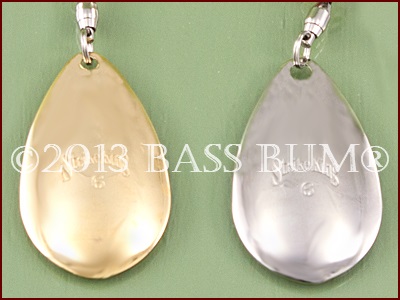
Blade Color
Nickel, silver (plated), gold or copper are the primary colors of spinnerbait blades. Nickel blades are best in clear water as they will give off much flash. In darker, stained water gold or copper generally perform better.
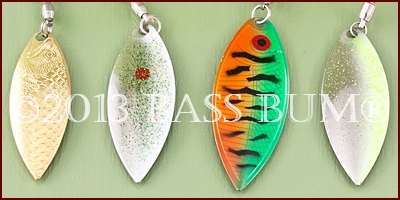
Spinnerbaits with painted blades are also available. I'm not sure blades painted "colors" have any more impact routinely than metal finished blades but I'm certain they can be impactful in certain situations. In clear water a "white" blade (one side) can perform well. If you're in muddy or badly stained water blades painted bright colors like orange, red or chartreuse may prove beneficial in attracting bass. Black blades are designed for night fishing or very low-light conditions.
In order to preserve the "flash" feature, blades painted on "one" side only should be a primary consideration when you're considering using them.
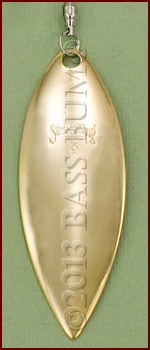
Blade Surface
Since a primary purpose of blades is to create "flash" to attract the attention of bass, consideration should be given to the surface of blades and how it affects this flash.
Blades are produced in smooth or hammered (textured) surfaces.
Smooth surfaces, whether nickel or gold, give off singular, large, bright flash in a limited number of directions. The smooth blade is probably perceived by bass as a single, larger baitfish or maybe even a predator. In the case of the latter it might even cause caution on the part of the bass rather than trigger an instinctual strike.
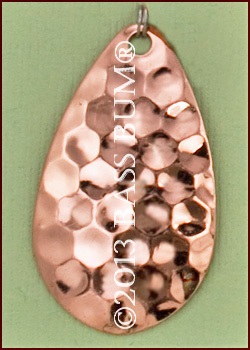
A hammered surface creates multiple flashes in numerous directions that may be perceived by bass as several fish. Generally less bright than smooth surface blades, they are also less threatening to spooky bass. Because of this bass may be more inclined to seek out the source of this subdued flash, which is exactly what we want them to do.
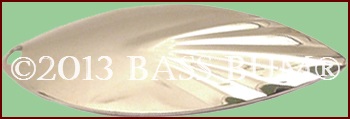
Fluted and rippled spinnerbait blades create multiple flashes in numerous directions as well as unique water displacement and vibrations.
Though fluted spinnerbait blades are found on bass versions of these lures the rippled blade is more often than not found on in-line spinners rather than L-shaped, safety pin spinnerbaits.
I think the jury is still out on whether these catch more bass than the traditional styles.
Blade Spin and Motion
Water disturbance from spinning blades is a short distance, visual trigger for bass.
Willowleaf blades, especially smooth surface models, rotate (spin) faster than other shapes. Colorado blades spin less rapidly than willowleaf blades because their resistance to water is greater. They are often described as creating "thumping" when retrieved. Indiana blades are between the other two as to spin speed and vibration. This makes it the most subtle of these three blade types and arguably the best for spooky fish or when fishing clear, bright days.

Blade Combinations
The overwhelming majority of bass fishermen today use two tandem spinnerbait blades. The two combination's most often seen are the Colorado/Willow and the most popular of all, the Double Willow.
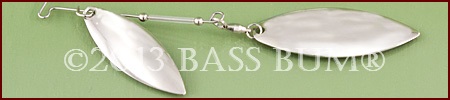
Tandem Willowleaf Blade Combination
Willowleaf blades turn on a tight arc around the wire frame and as a consequence more rapidly than any other design. They have less vibration than other spinnerbait blades but because of their very rapid spin they have more flash than either Colorado or Indiana blades. This is especially true of the larger willow blades. Basically, willow blades with the "same surface area" as "comparable surface area" Indiana or Colorado blades will produce more flash than they will.
The tight spin of willowleaf blades enable spinnerbaits to move easily through grass with less chance of clogging.
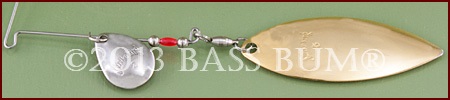
Tandem Colorado and Willowleaf Blades
A most popular, if not the most popular combination. This set up can be fished deeper than the double willow combination because of the wide arc rotation and increased water displacement of the front Colorado.
It's arguably the most logical combination of spinnerbait blades producing both flash and vibration and a lure that can be fished at a slightly slower speed than tandem willowleaf combinations.
This is a good blade arrangement for "waking" during a fast retrieve, if a small Colorado, say a No.2 is joined with a No. 4 1/2 or No. 5 willowleaf on a 3/8 oz lure body.
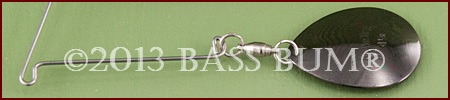
Single Colorado Blade - Black
This single blade produces significant water displacement and "thumping" vibration. It is very good in situations where bass are unable to see the lure as at night, in and around grass (clogging can be a problem) or in heavily stained water.
Since this blade creates the most "lift" of all spinnerbait blades it is a good choice for fishing shallow water and in or through cover. Helicoptering a spinnerbait down a bluff wall calls for a single-spin Colorado.
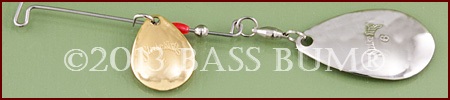
Tandem #2 Colorado and #6 Indiana
Not a common combination of spinnerbait blades but one that produces "thump" from the small Colorado blade and a subdued amount of vibration from the rear Indiana.
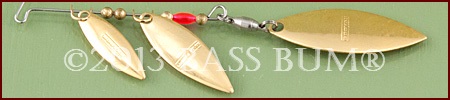
Tandem Multi Willow Blades
For creating the impression of a group of baitfish try a triple willowleaf combination.
Return To Spinnerbaits From Spinnerbait Blades
