Bass Fishing Rods
A Combination Of Form, Function And Beauty - Works Of Art
When I gaze upon racks of bass fishing rods at any of my favorite tackle shops, I see sleek, shiny, beautiful creations. Tools that are, as far as I'm concerned, also works of art. The combining of fishing rod parts to sculpt a tool that is at the same time strong, durable and able to withstand the forces placed upon it by a bass fighting desperately to get away, while being beautiful to the eye is no small accomplishment.
This is true whether they're graphite fishing rods, fiberglass fishing rods, flipping sticks or ultralight fishing rods. Whether they're spinnerbait rods, jerkbait rods, jigging rods, swimbait rods, a crankbait rod or a worm rod.
When you hold a rod in your hand you're holding a piece of the evolutionary technology that has transformed the once humble fishing pole into the exquisite tool it is today. I don't care what some may say, that all rods are the same. Nothing could be farther from the truth.
A High Quality Rod Is Not Necessarily A "Good" Rod
A rod must enable the angler to cast accurately and work his lure effectively for specific presentations. It should have a "sensitivity" that transmits maximum "feel" of what is happening on the end of the line. This sensitivity must serve to detect even the softest of bites whether in open water or thick cover, so the angler can know to set the hook. Of course the rod must also be of a structure and design that will successfully result in not only hooking the bass but also landing the bass in any given situation.
These are really the only traits that really determine whether you have a "good" rod. It's not the materials, the finish, the individual different fishing rod parts. These things determine if it's a quality rod. For example, You could have the best "drop shot" rod money could buy but if you're using it for flipping a jig-n-pig success is doubtful. No single rod is "good" for all baits, presentations or applications.
If you're just starting to bass fish focus on one technique in which you have the most interest. Buy one or two of the best technique specific bass fishing rods you can for that technique and bait(s). Fish them till you are successful with them before moving to others. In the beginning go for the basics, plastic worms or spinnerbaits.
So when choosing and using bass fishing rods, you want (1) the best quality rod you can afford made for the specific application(s) in which you're going to use it. And (2) you want the rod to work well in your hands by matching it to your fishing skills. Your collection of rods and reels should grow as your skills do, not before.
Types Of Fishing Rods
There are two primary type of bass fishing rods
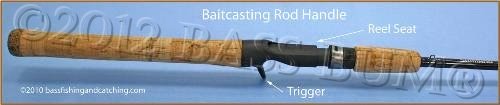
Baitcasting Rods are characterized by the reel being located on the top of the rod. Handles on these bass fishing rods are usually shorter than found those on spinning rods. They also have what is referred to as a "trigger grip" which enhances the anglers ability to securely hold and thumb the reel as line is released. Line guides are also located along the top of the rod and are quite small in diameter compared to those on spinning rods.
Baitcasting rods are favored, especially in the South, for all applications but those classified as finesse. This stance is steadily changing as technology advances the capabilities of spinning reels and rods.
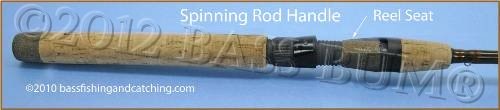
Spinning Rods are designed to have the reel "hang" below, or on the bottom of the rod. Line guides are spaced along the bottom of the rod and there is no "trigger grip". In order to provide balance handles of spinning rods run longer than those of baitcasting rods.
Most often thought of as bass fishing rods for finesse techniques, spinning rods are being continually introduced today that are technique specific and suitable for heavier applications. These are being matched with spinning reels that are also being designed for heavier applications. A great many techniques you can fish with a baitcasting rod can now be done with a spinning rod.
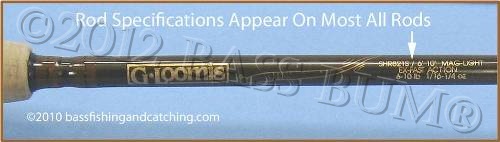
Rod Specifications - You'll Find Them On The Rod
You'll find printed bass fishing rods the specifications for that rod. These will be located just above the reel-seat and they will inform you of that rod's performance characteristics. What you'll find will appear something like these examples:
Shimano (Spinning) CPS-66MHB Length: 6'6" Line WT: 8-17lb Lure WT: 3/16-7/8oz Power: Medium Heavy Action: Fast
G.Loomis (Spinning) SHR821S / 6'10" MAG-LIGHT EX-FAST ACTION 6-10lb 1/16-1/4oz
St Croix (Spinning) MBS68MXF 6'8" MEDIUM POWER EXTRA-FAST ACTION SCII GRAPHITE 6-12LB 3/16-5/8OZ.
All Star (Flippin' Stick) TAS 908BB Length 7'6" Line Wt 12-30lb Lure Wt 3/8-2oz Fast Heavy
In each case above what you are seeing is (1) the item number,
(2) the length, (3) line and lure weight for which the rod is rated and
(4) the action and power rating for the rod, though
not necessarily in that order. This information tells you the
performance characteristics of that rod. Those specifications of a G.
Loomis rod are shown in the above picture.

Matching Techniques and Rods
General Guidelines
- Worm and Jig Rod - This is perhaps the rod you will use most of all bass fishing rods so is logically the first you should buy. A rod with the following traits is what is called for in a worm rod. For any lure 1/2 ounce or lighter this rod will work fine.
- Baitcasting Or Spinning Rod
- A 6'6" to 7' long, medium or medium-heavy power, sensitive graphite rod.
- A fast action, soft tip will allow for accurate casting and help maintain tension on the fish during the fight.
- Bass fishing rods with strong backbones for hook sets and pulling bass from cover is a must.
- This rod can also be used for Carolina rigs.
- Baitcasting
- A rod 6'6" in length enables accurate casting, a 7'plus rod is better for making long casts.
- Medium action, medium power, unless deep cranking then medium-heavy is better.
- Fiberglass construction is considered a positive by many as the hook set is cushioned by the rod's soft flex and hooks are less likely to be pulled from the bass' mouth. There is a distinct loss of feel with fiberglass in my humble opinion.
- crankbaits require continual casting over long periods so rod weight is a significant factor.
- For heavier crankbaits up to a full ounce I use the Quantum KVD Crankin' Rod (TKVD745M) which is 7'4" long, medium-heavy power and moderate action. This rod has a substantial backbone and a very quick tip. This rod is a composite of graphite and E-Glass fiberglass.
- Spinning
- Historically these bass fishing rods have not been rods for crankbaits or jerkbaits. This has recently changed with the introduction of high modulus graphite rods. These new rods, with strong backbones and soft, light tips that mimic the softer action of fiberglass rods, are made specifically for small to medium sized crankbaits.
- A spinning rod 7' or longer will enable an angler to throw these lures a country mile and avoid spooking bass. A 7', 7 1/2' even 8' rod is a great choice for slinging lipless crankbaits over the horizon in open water and then getting the lure "down to its max depth on the retrieve".
- If fishing specific targets ,like docks, underwater humps, rock piles or man made brush piles and accuracy is key, a rod 5'or 5 1/2' will do well for you.
- I've grown very fond of the new Shimano 6' 8", medium, medium-fast "crankbait-spinning" rod (CRSC68M) for lighter crankbaits.
- Baitcasting
- A 5' 6" long, medium power, pistol-grip baitcasting rod is considered by some to be the for accurate spinnerbait fishing.
- However, 6' 6" long, medium power, fast action rod is also good for accurate, short casting to specific targets often no more than 25-30 feet away.
- Any spinnerbait rod needs to have a good backbone as spinnerbaits are often heavy. Weights of 3/8, 1/2 and 3/4 ounces are very common.
- If you're fishing spinnerbaits in open water and making long casts a rod that is 7' or longer with a long handle is a good choice.
- Spinning
Want to know more about fishing rod components and how they contribute to the creation of "quality" bass fishing rods? Check out the links below.
Combine A Fishing Rod Blank, A Scrim and Some Resin And What Do You Get? The Foundation Of A Fishing Rod.
Fishing Rod Guides, Before Buying Your Rod, Make Sure Its Guides Are Good Quality, Placed Correctly And In The Right Quantity
Fishing Rod Action. What is It? Is it Important?
Alabama Rig Fishing Rods. Technique Specific Features Require!
A Swimbait Rod is the Most Critical Piece of Gear When Fishing Swimbairts
Your Crankbait Rods Require Particular Performance Features If You Want To Maximize Your Crankin' Success
Choosing A Rod To Be Your Jerkbait Rod Is Serious Business
Return To Bass Fishing and Catching From Bass Fishing Rods
